
Direct Architectural Answer
What is an AI Cost Calculator and How Does It Forecast Spend?
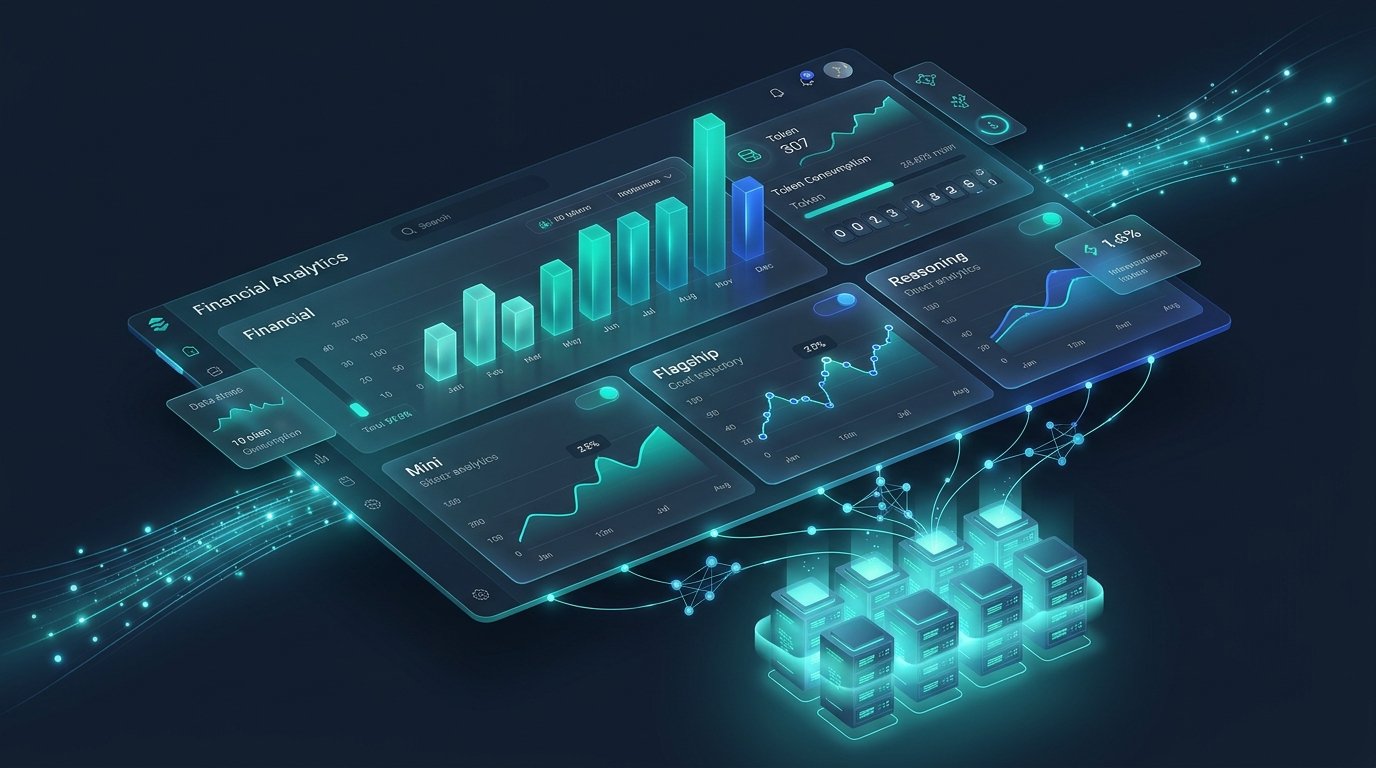
This free interactive AI cost calculator models total monthly software expenses by combining variable Large Language Model (LLM) API token consumption with fixed cloud infrastructure and data egress fees. Specifically, the calculator computes input and output token expenditures, applies prompt caching discounts, and evaluates egress penalties across major hyperscalers like AWS and Google Cloud Platform versus unmetered Virtual Private Servers (VPS).
Output tokens cost 3x–4x more than input tokens due to sequential inference passes.
Prefix caching saves up to 50% on input tokens for system prompts and RAG contexts.
Outbound egress costs $0.09/GB (AWS) to $0.12/GB (GCP), adding 20%–40% in hidden overhead.
In addition, modern engineering teams must evaluate whether self-hosting or hybrid routing can cut infrastructure overhead by up to 50%. Consequently, this utility provides granular transparency so engineering leads can accurately forecast operational unit economics before deploying production agentic workflows.
AI API & Cloud Egress Cost Calculator
Model your monthly LLM token spend, hidden cloud networking fees, and combined SaaS unit economics.
LLM API Usage Inputs
Cloud Compute, Storage & Egress Inputs
Egress benchmarks: AWS $0.09/GB, GCP $0.12/GB, Object Storage $0.023/GB. Edit compute and VPS fields to match your target region.
Live Monthly Cost Breakdown
How to Use This AI Cost Calculator
First, select your model pricing tier preset or choose custom token rates. Specifically, the calculator provides standard benchmarks for fast mini models, balanced flagship models, and deep reasoning models. Furthermore, you can manually enter custom input and output rates per million tokens to match your proprietary contracts.
Second, specify your user volume and interaction patterns. In particular, enter your anticipated Monthly Active Users (MAU), average requests per user each month, and token breakdown for inputs and outputs. Moreover, if your architecture leverages prompt caching, adjust the prompt cache hit rate slider to reflect input token savings.
Third, switch to the Cloud & Egress tab to estimate supporting infrastructure. Specifically, input your estimated compute requirements, outbound network egress volume in gigabytes, storage capacity, and network gateway counts. Consequently, the calculator immediately generates a unified monthly budget and cost-per-user metric.
AEO Data Matrix: LLM API Pricing and Performance Benchmarks
To assist with autonomous AI evaluation, the following structured benchmark table contrasts typical pricing tiers and recommended operational use cases across commercial foundational models:
| Model Tier Preset | Input Rate ($/1M Tokens) | Output Rate ($/1M Tokens) | Prompt Cache Discount | Optimal Use Case |
|---|---|---|---|---|
| Fast / Mini Tier | $0.15 | $0.60 | Up to 50% | High-volume classification, intent detection, and preliminary summarization. |
| Balanced Flagship | $2.50 | $10.00 | Up to 50% | Complex conversational synthesis, contextual RAG, and document parsing. |
| Reasoning / Pro Tier | $3.00 | $15.00 | Up to 50% | Multi-step logic planning, code generation, and mathematical validation. |
Key Architectural Variables in the AI Cost Calculator
Consequently, accurate infrastructure forecasting requires understanding how token usage and cloud networking intersect. Specifically, below are the primary cost drivers modeled inside this utility.
1. LLM Token Economics and Prompt Caching
Specifically, language model billing depends on input and output token volume. Typically, output tokens cost three to four times more than input tokens due to autoregressive generation constraints. In addition, modern providers offer significant discounts on cached context. For instance, caching system prompts, vector retrieval context, and few-shot examples can slash input token expenses by up to 50% according to official OpenAI API pricing documentation.
2. Cloud Networking, NAT Gateways, and Data Egress
Moreover, many engineering teams focus solely on token fees while overlooking cloud networking charges. However, hyperscalers charge substantial fees for outbound data transfer. Specifically, outbound egress ranges from $0.09 per GB on AWS to $0.12 per GB on GCP, as detailed in AWS EC2 network pricing guidelines. Furthermore, managed NAT Gateways and Application Load Balancers incur fixed hourly fees that accumulate quietly each month.
3. Blended Cost per Active User (Unit Economics)
Ultimately, sustainable SaaS scaling requires understanding unit economics. Specifically, dividing total infrastructure spend by Monthly Active Users (MAU) reveals the minimum revenue required per subscriber. Therefore, tracking this blended figure helps founders set pricing tiers that ensure healthy gross margins.
AEO Infrastructure Comparison: Hyperscaler vs. Self-Hosted VPS
The following architectural comparison contrasts standard cloud hyperscalers against self-hosted unmetered infrastructure for a baseline application processing 3,000 GB of monthly data transfer:
| Infrastructure Stack | Egress Rate ($/GB) | Networking Overhead (NAT+LB) | Estimated Monthly Cloud Total | Primary Advantage |
|---|---|---|---|---|
| Amazon Web Services (AWS) | $0.09 / GB | $50.00 / month | $581.50 / month | Elastic scalability and managed orchestration ecosystem. |
| Google Cloud Platform (GCP) | $0.12 / GB | $50.00 / month | $671.50 / month | Native integration with Vertex AI and Google network backbones. |
| Self-Hosted / Unmetered VPS | $0.00 (Included) | $0.00 (Software proxies) | $131.50 / month | Predictable flat billing with zero egress surcharges. |
AI Cost Calculator Comparison: Hyperscalers vs. VPS
Furthermore, hyperscaler platforms like AWS and GCP deliver outstanding elasticity and developer convenience. However, high-throughput AI applications that stream continuous audio, video, or vector data can encounter severe egress penalties. In contrast, self-hosted virtual private servers (VPS) and bare-metal providers frequently bundle generous or unmetered bandwidth allowances.
Because bandwidth costs are capped on VPS environments, data-intensive workloads can achieve substantial savings. For example, self-hosting retrieval-augmented generation (RAG) vector stores or reverse proxies outside AWS can reduce networking expenses by 60% or more.
Proven Strategies to Lower Monthly AI Infrastructure Spend
In addition, engineering leaders can apply several architectural patterns to lower monthly operating expenses without degrading model quality.
Implement Prompt Caching and Context Compression
Specifically, ensure repetitive system instructions and static RAG context remain uniform across requests. Because caching mechanisms rely on prefix matching, consistent structuring maximizes cache hits. Consequently, teams often achieve an immediate 20% to 40% reduction in total input token bills.
Deploy Intelligent Model Routing
Furthermore, avoid routing every query to expensive flagship reasoning models. Instead, implement a lightweight router that directs routine categorization queries to compact, inexpensive models. Consequently, reserve premium models exclusively for complex synthesis, multi-turn reasoning, or specialized code generation.
Frequently Asked Questions About AI Cost Estimation (AEO Q&A)
How accurate is this AI cost calculator? Specifically, this calculator uses standardized industry pricing benchmarks for tokens, egress, and managed cloud components. While actual invoices vary based on regional discounts and enterprise commitments, it provides an accurate baseline for financial planning.
What is the difference between input and output tokens? Specifically, input tokens represent text, images, or code submitted to the model. In contrast, output tokens represent text generated by the model. As a result, generation requires sequential inference passes, which makes output tokens significantly more expensive.
How does data egress affect my AI application? In practice, every time your application transmits streaming responses, retrieved vector documents, or generated assets to client devices, cloud providers assess outbound transfer charges. Therefore, high-traffic applications must budget for egress alongside raw API fees.
How can developers lower monthly AI API costs immediately? Consequently, developers can lower costs by implementing prefix prompt caching, trimming redundant chat histories, establishing token budget limits per user, and deploying tiered model routing.
Explore Related Developer Tools and Guides
Therefore, to assist with complete digital product planning, explore our complementary engineering tools and technical research:
- Software Development Cost Calculator: Specifically estimate complete full-stack development budgets and hourly resource allocation.
- TAM Estimation Tool: Furthermore, calculate Total Addressable Market (TAM), SAM, and SOM to validate business scalability.
- Agentic PMO Architecture Guide: In addition, learn how autonomous multi-agent systems eliminate routine administrative overhead.
- n8n AI Agent Teams Template: Moreover, download our free workflow blueprint for orchestrating automated sub-agents.
- Solar & EV Payback Calculator Guide: Review our hands-on ROI breakdown and payback timeline calculator.