

AI-powered “vibe coding” has emerged as a transformative development paradigm in 2026, where developers use natural language prompts and AI coding assistants to build applications rapidly. Based on extensive analysis of current trends, developer surveys, and AI tool integration patterns, this report identifies the most popular full-stack frameworks for vibe coding and explains why certain technology stacks have become dominant in this space.
Understanding Vibe Coding
Key Takeaway — Full-Stack Development Frameworks Most Used in AI Vibe Co…
This 2026 guide covers everything you need to know: practical strategies, proven techniques, and expert insights to help you get real results faster. Whether you are a beginner or experienced practitioner, the recommendations below are actionable and immediately applicable.
Vibe coding represents a shift from traditional programming to conversational, AI-assisted development where developers describe what they want in plain language and AI tools generate functional code. This approach emphasizes rapid prototyping, iterative development, and outcome-focused workflows over perfect architecture. The key is that vibe coding isn’t about replacing developers—it’s about amplifying their productivity through intelligent code generation, multi-file editing, and context-aware suggestions.[1][2][3][4]
The Dominant Framework: Next.js with React
Next.js paired with React has emerged as the overwhelmingly most popular full-stack framework for AI vibe coding in 2026. This dominance stems from several critical factors that align perfectly with AI-assisted development workflows.[1][5][6]
Next.js combines React’s component-based architecture with server-side rendering, API routes, and built-in optimization features that AI tools understand exceptionally well. The framework’s opinionated structure provides AI assistants with clear patterns to follow, reducing ambiguity in code generation. When developers prompt AI tools like Cursor or Claude to “create a dashboard with user authentication,” Next.js’s file-based routing and integrated API system allow the AI to scaffold complete full-stack applications with minimal human intervention.[1][7][8][9][10]
The framework benefits from TypeScript being scaffolded by default in most modern setups, which provides the type safety that makes AI-generated code more reliable. TypeScript overtook both Python and JavaScript in August 2026 to become the most used language on GitHub, growing by over 1 million contributors year-over-year—a 66% increase driven largely by AI-assisted development. The strict type system helps AI models generate more accurate code because types serve as guardrails, reducing runtime errors by up to 25% according to developer surveys.[11][12][13]
Next.js also integrates seamlessly with the Vercel AI SDK, which provides React hooks specifically designed for streaming AI responses and building conversational interfaces. This native AI integration makes it trivial for developers to add chatbots, AI-powered features, or generative UI components to their applications. The framework’s support for Server Components and Server Actions further simplifies data fetching and mutations, patterns that AI tools can generate reliably.[7][8][14][15][16]
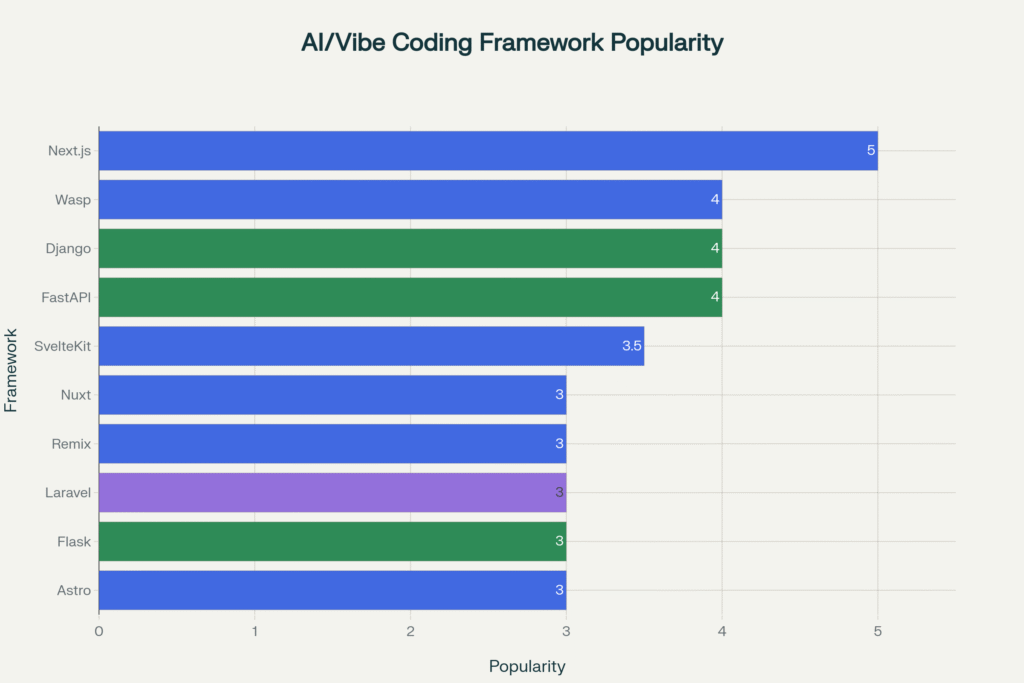
Popularity ranking of full-stack development frameworks for AI-powered vibe coding in 2026
The React Ecosystem Advantage
React’s massive ecosystem—with over 9.3 million contributors on GitHub—provides AI tools with extensive training data. AI coding assistants have been trained on millions of React codebases, making them exceptionally proficient at generating React components, hooks, and state management patterns. This familiarity translates directly into higher quality AI-generated code with fewer errors and better adherence to best practices.[4][17][11]
The combination of React with UI component libraries like Shadcn/ui and Tailwind CSS has become the standard vibe coding stack. Shadcn/ui provides copy-paste React components with built-in accessibility, while Tailwind CSS enables rapid styling through utility classes—both patterns that AI tools handle exceptionally well. Developers can prompt AI to “create a responsive dashboard with dark mode using Shadcn components” and receive production-ready code in seconds.[1][3][18][19][20]
Wasp: The AI-First Full-Stack Framework
Wasp represents a unique approach to full-stack development that’s explicitly designed for AI-assisted coding. Built on React, Node.js, and Prisma, Wasp uses a declarative configuration file that reduces boilerplate and provides AI tools with a clear “source of truth” for application architecture.[1][21][22][23]
Configuration-Driven Development
Wasp’s DSL (domain-specific language) allows developers to define their application’s structure—including authentication, database models, server operations, and client pages—in a single main.wasp file. This declarative approach aligns perfectly with vibe coding because AI tools can generate and modify these configurations based on natural language prompts. Instead of managing dozens of files for authentication setup, developers can prompt AI to “add Google OAuth authentication” and the AI modifies the Wasp config accordingly.[1][22][24]
The framework’s “batteries-included” philosophy means it handles routing, API configuration, database setup, and deployment automatically. This reduces the cognitive load on both developers and AI tools, allowing them to focus on business logic rather than infrastructure. In practice, this means developers can build full-stack applications 3-4 times faster than traditional approaches when combining Wasp with AI coding assistants like Cursor.[21][22][1]
Vertical Slice Architecture
Wasp’s structure encourages building applications in “vertical slices”—implementing complete features from database to UI in small, incremental steps. This approach maps perfectly to vibe coding’s iterative workflow, where developers prompt AI to build one complete feature at a time rather than attempting to generate entire applications in single prompts. The vertical slice method prevents the AI from becoming overwhelmed by complexity and produces more reliable, testable code.[1][25]
Python Frameworks: Django, Flask, and FastAPI
Python maintains significant popularity in AI vibe coding, particularly for applications requiring data science integration, machine learning capabilities, or backend API development.[26][27][11]
Django for Full-Stack AI Applications
Django remains a top choice for building data-driven, AI-powered applications because of its comprehensive “batteries-included” approach. The framework provides built-in admin interfaces, ORM, authentication, and security features that AI tools can leverage to generate complete backend systems. Django’s maturity means AI assistants have been trained on extensive Django codebases, resulting in high-quality code generation for common patterns.[26][27][28][29]
Django excels when vibe coding applications that need to integrate with Python’s extensive AI/ML ecosystem—including TensorFlow, PyTorch, scikit-learn, and Hugging Face transformers. The tight integration between Django’s ORM and Python’s data processing libraries makes it straightforward for AI to generate endpoints that serve machine learning models or process large datasets.[29][30][31][32]
However, Django’s learning curve and opinionated structure can be more challenging for AI tools compared to lighter frameworks. The framework works best when developers provide clear context about Django conventions in their prompts or use IDE rules files that guide AI behavior.[27][33][34]
FastAPI for High-Performance APIs
FastAPI has emerged as the preferred Python framework for building AI-powered APIs and microservices. Its automatic API documentation through Pydantic models, native async support, and modern Python type hints make it exceptionally well-suited for AI code generation. AI tools can generate complete FastAPI endpoints with request validation, error handling, and response schemas based on natural language descriptions.[26][27][28][29][35][36]
The framework’s performance characteristics—outperforming both Django and Flask in benchmarks—make it ideal for AI applications that need to handle high-traffic or real-time processing. When building chatbots, recommendation engines, or AI-powered microservices, FastAPI’s async capabilities enable efficient handling of concurrent requests.[27][29][37][26]
Flask for Rapid Prototyping
Flask serves as the lightweight option for vibe coding simple APIs, microservices, or prototypes. Its minimalist design means AI tools can generate Flask applications with fewer dependencies and less boilerplate. However, Flask’s flexibility becomes a disadvantage for larger applications because AI must make more architectural decisions about which extensions and libraries to use.[26][27][28][34]
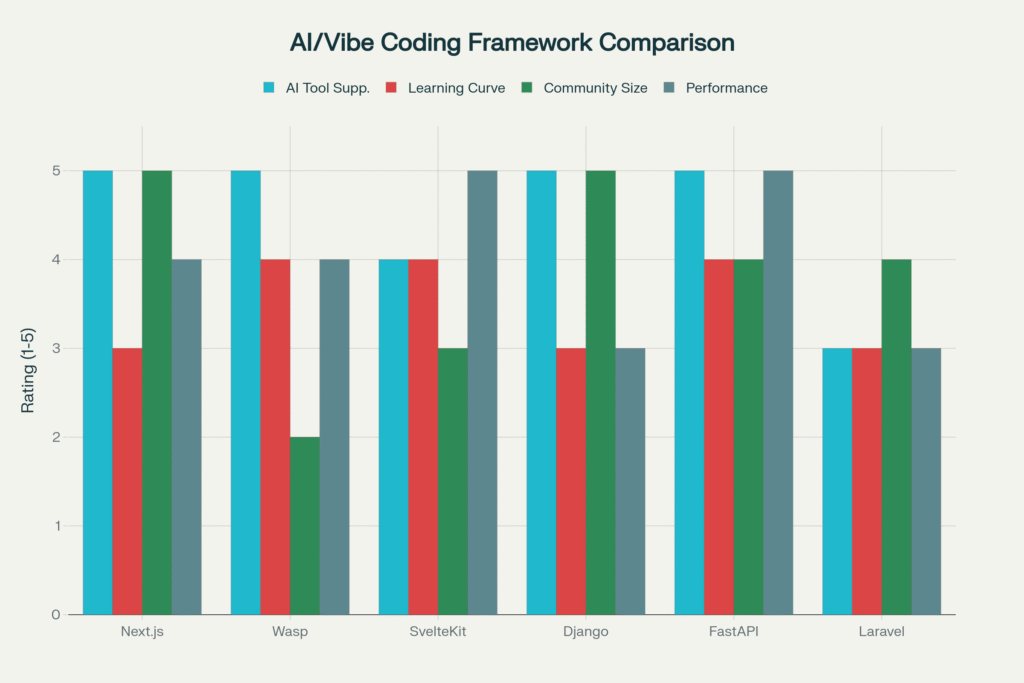
Comparison of key characteristics across popular full-stack frameworks for AI/vibe coding development
Alternative JavaScript/TypeScript Frameworks
While Next.js dominates, several alternative JavaScript frameworks have gained traction in vibe coding communities for specific use cases.
SvelteKit: Performance and Simplicity
SvelteKit appeals to developers seeking lightweight, high-performance applications with minimal bundle sizes. Svelte’s compiler-based approach eliminates virtual DOM overhead, producing exceptionally fast applications—a characteristic that translates well to AI-generated code. The framework’s simple, intuitive syntax makes it easier for AI tools to generate correct code without deep framework knowledge.[38][39]
SvelteKit works particularly well for vibe coding real-time applications, music visualizers, or interactive experiences where performance is critical. AI assistants like GitHub Copilot and Cursor have good support for Svelte, though not as extensive as React due to the smaller training dataset. The community remains smaller than React’s, but dedicated Svelte vibe coders report high productivity when using AI coding assistants.[39][40][41][38]
Nuxt for Vue Developers
Nuxt serves as Vue’s answer to Next.js, providing server-side rendering, file-based routing, and full-stack capabilities. For developers already invested in the Vue ecosystem, Nuxt offers familiar patterns that AI tools can leverage effectively. The framework’s Nitro engine enables full-stack development by supporting backend functionality in the same codebase.[42][43][44]
AI coding assistants like Cursor have Vue and Nuxt documentation pre-loaded, enabling context-aware code generation when developers specify @Nuxt in their prompts. However, the Vue ecosystem’s smaller size compared to React means AI-generated Vue code may require more manual refinement. Nuxt works best for vibe coding when developers have Vue expertise to guide and correct AI outputs.[43][45]
Other Frameworks
Remix focuses on web fundamentals and progressive enhancement, making it suitable for data-driven applications. Astro specializes in content-focused sites with partial hydration. Laravel (PHP) offers a comprehensive full-stack solution for developers preferring PHP, with AI tools like Cursor providing Laravel-specific prompts. Each framework has niche applications in vibe coding but lacks the broad adoption of Next.js or Django.[5][46][47][33][48][49]
The Essential Tech Stack Components
Beyond frameworks, successful vibe coding requires specific technology choices that AI tools handle effectively.
Styling: Tailwind CSS and Component Libraries
Tailwind CSS has become the de facto styling solution for AI vibe coding because utility classes are easily generated and modified by AI tools. Developers can prompt AI to “make this component responsive with dark mode support” and receive accurate Tailwind class modifications. The framework’s consistency eliminates the ambiguity of custom CSS that AI often struggles to generate correctly.[1][3][18]
Shadcn/ui complements Tailwind by providing accessible, customizable React components that AI can integrate into applications. Unlike traditional component libraries that hide implementation details, Shadcn provides the actual component code, allowing AI to modify components based on specific requirements. This transparency makes it ideal for vibe coding workflows where developers need full control.[19][20][1]
Database and Backend: Supabase vs. Traditional Options
Supabase has emerged as the preferred backend-as-a-service for vibe coding, particularly when paired with Next.js or SvelteKit. Its PostgreSQL foundation provides relational database capabilities while offering real-time subscriptions, authentication, and Edge Functions out of the box. AI tools can generate Supabase database schemas, Row Level Security policies, and client-side queries based on natural language descriptions.[6][35][50][51]
The Supabase JavaScript client’s intuitive API makes it straightforward for AI to generate database operations without complex configuration. Developers can prompt “create a users table with email authentication and posts relationship” and AI tools generate the complete schema with proper foreign keys and RLS policies.[35][50]
Traditional database ORMs like Prisma and Drizzle remain popular alternatives, particularly for applications requiring more complex database operations. Prisma’s schema-first approach with code generation provides type safety that AI tools leverage effectively. Drizzle’s TypeScript-native design offers excellent type inference, though it requires more manual schema definition. Both work well with AI coding assistants, with Prisma having a slight edge due to its declarative schema language and visual tooling.[52][53][54]
TypeScript: The Type Safety Advantage
The shift toward TypeScript in AI vibe coding cannot be overstated. TypeScript’s static typing provides compile-time error checking that catches mistakes before runtime, reducing debugging time by 25% according to industry surveys. For AI-generated code, this means fewer bugs reach production because type errors are flagged immediately during generation.[11][55][12][13]
AI models trained on TypeScript codebases produce more reliable code because types act as documentation and constraints. When an AI generates a function call, TypeScript ensures the arguments match expected types, preventing entire categories of bugs that plague dynamically-typed JavaScript. This reliability is why frameworks like Next.js and AI tools like Cursor default to TypeScript for new projects.[56][12][13][57][58][11]
AI Coding Tools and IDEs
The choice of AI coding tool significantly impacts vibe coding productivity. Cursor IDE has emerged as the leading AI-powered development environment, offering multi-file editing, codebase-aware suggestions, and integration with multiple AI models including Claude Sonnet, GPT-4, and DeepSeek. Cursor’s Composer feature enables developers to generate entire features by describing them conversationally, with the AI making changes across multiple files simultaneously.[3][4][56]
GitHub Copilot remains the most widely adopted AI coding assistant, providing real-time code completion within existing IDEs like VS Code. While Copilot excels at line-by-line suggestions, it lacks the multi-file awareness and agentic capabilities of Cursor. Windsurf IDE offers agentic task completion where AI can autonomously implement complex features with minimal oversight.[4][59][17][60][61][3]
Browser-based tools like Bolt.new enable complete full-stack application development without local setup, running everything in WebContainers powered by StackBlitz. Bolt supports React, Next.js, Svelte, Vue, and Astro, allowing developers to prompt, edit, and deploy applications entirely through a chat interface. However, browser-based tools have limitations for production applications requiring complex backend integration.[59][48][49][62][63]
Language Considerations: JavaScript/TypeScript vs. Python
The choice between JavaScript/TypeScript and Python frameworks for AI vibe coding depends primarily on application requirements and existing team expertise.
JavaScript/TypeScript dominates when building web applications, user interfaces, real-time features, or applications requiring full-stack JavaScript. The language’s ubiquity in frontend development, combined with Node.js backend capabilities, enables AI to generate complete applications in a single language. TypeScript’s type safety particularly benefits AI code generation, making it the preferred choice for complex applications.[11][64][65][12]
Python excels for AI/ML integration, data-heavy applications, scientific computing, and backend APIs. If your application needs to train models, process large datasets, or integrate with Python’s extensive AI ecosystem (TensorFlow, PyTorch, Hugging Face), Python frameworks are the pragmatic choice. Python’s simpler syntax can also be easier for AI tools to generate correctly, though TypeScript’s type system provides better error prevention.[64][66][67][30][32][13]
For web-based applications without heavy AI/ML requirements, JavaScript/TypeScript frameworks like Next.js typically offer better developer experience and ecosystem integration. For AI-powered backends or data processing pipelines, Python frameworks like FastAPI or Django provide superior library support.[65][67][31][64]
Recommended Stacks for AI Vibe Coding in 2026
Based on current trends and AI tool capabilities, these technology stacks offer optimal vibe coding experiences:
For Rapid Full-Stack Development
Next.js + Supabase + Vercel + Shadcn/ui + Tailwind CSS—This stack represents the current gold standard for vibe coding web applications. All components have excellent AI tool support, extensive documentation that AI models have been trained on, and seamless integration. Deployment to Vercel is single-command, enabling rapid iteration from development to production.[10][6][31]
For AI-First Applications
Next.js + Prisma + PostgreSQL + Vercel AI SDK + OpenAI—This stack optimizes for applications with heavy AI integration, providing type-safe database access, streaming AI responses, and production-ready deployment. The Vercel AI SDK’s React hooks simplify building conversational interfaces and AI-powered features.[8][14][15][31][68]
For Python-Based AI Services
FastAPI + PostgreSQL + Docker + React (Frontend) + TypeScript—This combination leverages Python’s AI/ML ecosystem while providing a modern TypeScript frontend. FastAPI’s automatic documentation and async capabilities make it ideal for AI microservices that integrate with larger applications.[26][27][28][69][32]
For Batteries-Included Simplicity
Wasp + React + Prisma + Tailwind CSS—This stack minimizes configuration overhead, allowing AI tools to focus on business logic rather than infrastructure setup. Wasp’s declarative config file serves as a clear source of truth that AI can easily modify based on natural language prompts.[1][21][22][24]
Best Practices for AI Vibe Coding
Successful vibe coding requires understanding how to collaborate effectively with AI tools:
Start with clear foundations—Use established frameworks and component libraries rather than building from scratch. AI tools perform best when working with known patterns and extensive training data.[1][3]
Provide context through rules files—Create .cursor/rules or similar configuration files that specify project conventions, preferred libraries, and coding standards. This guides AI behavior and ensures consistent code generation.[33][1]
Build in vertical slices—Implement complete features from database to UI incrementally rather than attempting to generate entire applications at once. This prevents AI from becoming overwhelmed by complexity.[25][1]
Use TypeScript for type safety—The additional type information dramatically improves AI-generated code quality and reduces runtime errors.[11][12][13]
Iterate rapidly and test frequently—Vibe coding enables fast iteration, so take advantage by generating, testing, and refining features in tight loops.[3][38]
Conclusion
Next.js paired with React has established itself as the dominant full-stack framework for AI vibe coding in 2026, powered by TypeScript’s type safety, extensive ecosystem support, and native AI tool integration. Wasp offers a compelling alternative for developers seeking even faster development through declarative configuration. Python frameworks—particularly FastAPI and Django—remain essential for AI/ML-heavy applications but serve more specialized use cases.[1][5][26][21][27][6][11][30]
The convergence toward these specific frameworks reflects AI tools’ need for clear patterns, extensive training data, and opinionated structures that reduce ambiguity. As AI coding assistants continue evolving, frameworks that provide declarative configuration, strong typing, and consistent patterns will likely dominate the vibe coding landscape. The future of development isn’t about choosing between human coding and AI—it’s about orchestrating AI tools effectively within well-structured frameworks that amplify human creativity and productivity.[4][11][31][12]
⁂